Wakulla County’s Facebook Comment Shutdown: Who Decided - and Was It Allowed? 📣
Shutting off public comments without a BOCC discussion, public notice, or any transparent process is a terrible look for county leadership. Administrative policy doesn’t give the administrator a blank check to make sweeping communication decisions on his own—especially when those decisions cut off public access shortly after he publicly referred to residents as “Facebook idiots.”
2026ELECTED AND NON ELECTED OFFICIALS
1/26/20263 min read


In early January 2026, Wakulla County residents began noticing something strange on the county’s official Facebook pages: comments had quietly disappeared. Posts announcing Board of County Commissioners (BOCC) meetings, livestreams, and updates from departments like Library Services, Fire Rescue, and Recreation all shifted to one‑way communication overnight.
A public records request has now revealed exactly how this happened.
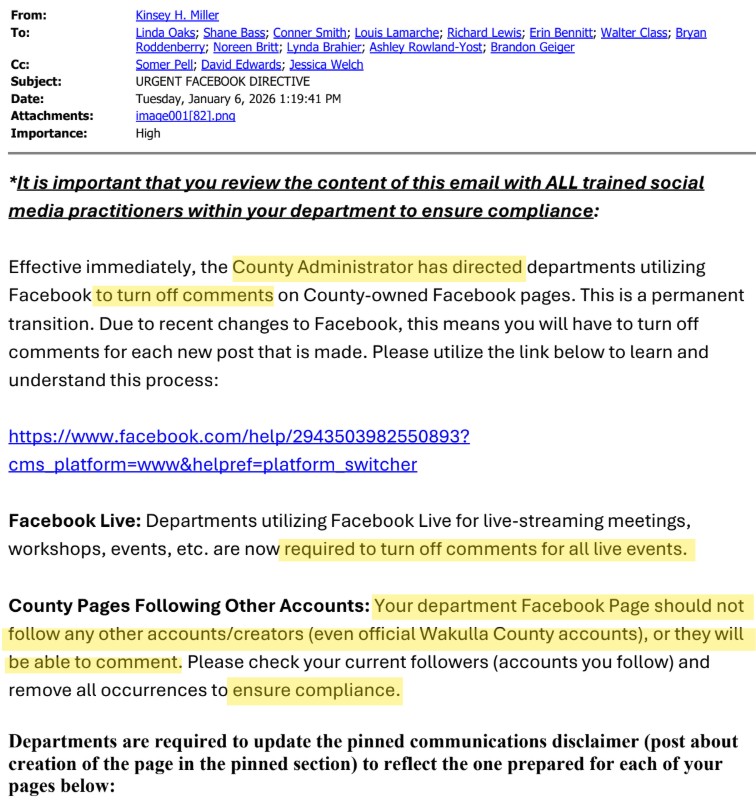
On January 6, 2026, Public Information Officer Kinsey Miller sent an internal email titled “URGENT FACEBOOK DIRECTIVE.” The message instructed every department to permanently disable comments on all county‑owned Facebook pages and livestreams. The email states plainly:
“The County Administrator has directed departments… This is a permanent transition.”
Departments were told to:
Turn off comments on every new post
Disable comments on all Facebook Live events
Unfollow all other accounts (including other county pages) to prevent cross‑commenting
Replace their pinned disclaimers with new language declaring the page “one‑way communication only”
This wasn’t a technical adjustment. It was a county‑wide policy shift — implemented internally, without a BOCC vote, workshop, or public discussion.
So the question becomes: Did the County Administrator actually have the authority to do this? 🧐
To answer that, we look at the three governing sources: Florida Statute § 125.74, the Wakulla County Home Rule Charter, and Administrative Regulation (AR) 1.08.
1. Florida Statute § 125.74: The Administrator Executes Policy — He Doesn’t Create It
Florida law draws a bright line between policymaking and administration.
§125.74(1)(a): The administrator must “administer and carry out the directives and policies of the board.”
That means implementing BOCC decisions — not inventing new ones.§125.74(2): The Legislature’s intent is explicit:
Policymaking stays with the BOCC.
The administrator gets only administrative and executive powers.
The statute lists duties like budgeting, personnel management, and property oversight.
Nothing authorizes the administrator to restrict public speech or redefine how residents can interact with BOCC communications.
A permanent, county‑wide comment ban — especially on BOCC meeting livestreams — is not “administration.” It is a policy decision.
And under Florida Statutes, policy decisions belong to the elected board.
2. Wakulla County Home Rule Charter: Separation of Powers by Design
The Charter is even clearer.
Article 1, Sec. 1.6:
“The establishment and adoption of policy shall be the responsibility of the board of county commissioners…”Article 3, Sec. 3.3:
The administrator manages operations and executes BOCC policy.
No authority is granted to restrict public participation or alter communication channels.Article 2, Sec. 2.7:
The BOCC holds all legislative authority.Article 2, Sec. 2.9:
The BOCC adopts the Administrative Code — not the administrator.
A permanent shift to one‑way communication on official platforms is a policy change, not an operational tweak.
The Charter reserves that power for the BOCC alone.
3. AR 1.08 (2017): Operational Guidance, Not a County‑Wide Mandate
Administrative Regulation 1.08 governs social media use.
Sec. E.4:
Page Administrators may allow two‑way communication at their discretion.
This is per‑page flexibility - not a blanket rule.Secs. C & D:
Only authorized employees may manage pages, but their authority is operational, not legislative.Purpose statement:
Social media exists to “disseminate information and increase public awareness.”
Nothing in AR 1.08 authorizes:
A county‑wide, permanent comment ban
Forced disclaimer changes
Prohibiting pages from following other accounts
A top‑down directive from the administrator
The regulation gives limited operational discretion, not policymaking power.
The Gray Area: “Act First, Ask Forgiveness Later” ⚠️
Here’s the dynamic the email exposes:
The administrator issues a directive internally.
Departments implement it immediately.
The public loses access overnight.
The BOCC is never informed.
The burden shifts to residents to notice, object, or challenge it.
This is how de facto policy gets created without ever going through the proper channels.
It’s not illegal because it’s forbidden.
It’s questionable because it’s not authorized.
Why This Matters - Especially for Residents Who Rely on Accessibility
Turning off comments isn’t a minor change. For many residents, Facebook comments are:
The only accessible way to ask questions
A real‑time method to engage with BOCC meetings
A substitute for in‑person attendance
A way to participate without mobility, transportation, or verbal communication barriers
Email and phone calls exist, but they lack visibility, immediacy, and community dialogue.
When the county promotes Facebook as a tool for public awareness but then disables public input - especially on meeting livestreams - it raises serious concerns about transparency and accessibility.
Where the BOCC Can Step In
If commissioners choose to address this, they could:
Place the issue on a future agenda
Direct the administrator to restore comments on meeting‑related posts
Amend AR 1.08 to require BOCC approval for major changes to public engagement
Local government works best when residents can see, speak, and participate.
When communication tools change without public input — especially in ways that limit voices — it’s worth asking questions.
Additional Social Links
YouTube is your go-to for short clips, video explainers, and visual breakdowns of how Florida and Wakulla governments really work.
Facebook brings you bite-sized written content, sticky-note facts, and rolling updates you can share and discuss.
NEW! TikTok You can now follow Wakulla Reports on TikTok for quick updates and BOCC video clips.
Prefer to browse at your own pace?
Bookmark our website and visit anytime for fresh posts, resources, and real-life examples from right here in Wakulla County.
© 2024. All rights reserved.